Asymptotic notation


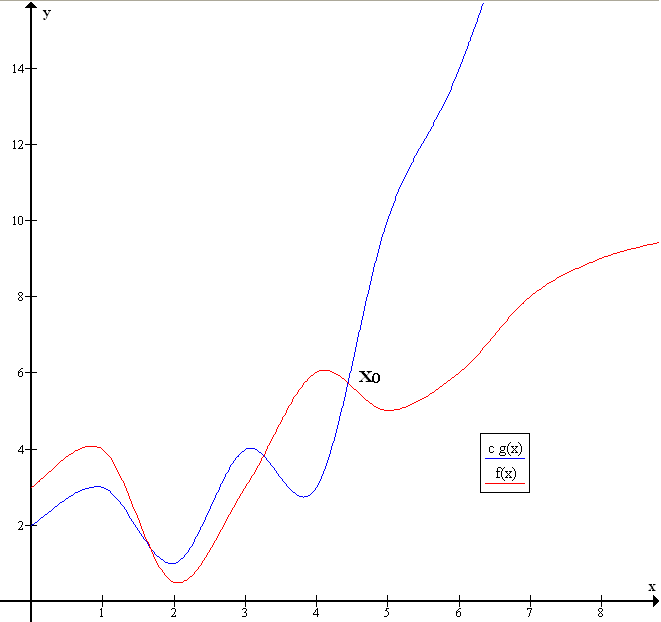
Image of function f(x) bounded from above by function g(x)
Example: \(f(x) \in O(g(x))\)

Asymptotic notation characterizes the limiting behavior of a function based on its growth rate. It allows for algorithms to be classified according to how their runtime grows as a function of input size, essentially serving as a measure of time complexity; how efficient an algorithm is with time.

Contents

Big \(O\)


Big \(O\) notation describes the asymptotic upper bound of a function. If a function is "Oh of" some other function, then for sufficiently large inputs, it will always be below that other function.

Let \(f\) and \(g\) be functions \(\mathbb{Z}^{+} \rightarrow \mathbb{R}^{\geq 0}.\) Then, \(f \in O(g)\) if and only if there exist \(c \in \mathbb{R}^{+}\) and \(n_0 \in \mathbb{R}^{+}\) such that for all \(n \geq n_0\): $$f(n) \leq c * g(n)$$

Basically, \(f \in O(g)\) if \(f\) is always bounded from above by \(g\) multiplied by some positive constant \(c\) after \(n\) exceeds \(n_0.\)

To prove Big \(O\), all you need to do is find a single witness \((c, n_0)\) that fulfills the above definition.

If \(p\) is a degree-\(k\) polynomial function, to quickly prove \(p(n) \in O(n^k)\), try \(n_0 = 1\), and set \(c\) equal to the sum of all positive coefficients and constants in \(p(n).\) That combination is guaranteed to work as a witness.

To disprove Big \(O\), you need to show that for all \(c \in \mathbb{R}^{+}\) and \(n_0 \in \mathbb{R}^{+}\), there exists \(n \geq n_0\) such that \(f(n) \gt c * g(n).\) In other words, no matter what witness \((c, n_0)\) you select, there's always going to be some eventual \(n \geq n_0\) that allows \(f(n)\) to exceed \(c * g(n)\), which disqualifies \(g(n)\) from being an upper bound of \(f(n).\) A proof by contradiction will get the job done. Assume there is a witness that fits the definition of Big \(O.\) Then, show how this forces \(n\) to have an upper bound, which is absurd.

⚠ You may see the popular notation \(f = O(g)\), read as "\(f\) is Oh of \(g.\)" Here, the equals sign is not being used to express equality, but instead a colloquial "is." To avoid misleading others, we write \(f \in O(g)\), where \(O(g)\) is interpreted as the set of all functions that are "Oh of" \(g.\)

Big \(\Omega\)


Big \(\Omega\) notation describes the asymptotic lower bound of a function. If a function is "Omega of" some other function, then for sufficiently large inputs, it will always be above that other function.

Let \(f\) and \(g\) be functions \(\mathbb{Z}^{+} \rightarrow \mathbb{R}^{\geq 0}.\) Then, \(f \in \Omega(g)\) if and only if there exist \(c \in \mathbb{R}^{+}\) and \(n_0 \in \mathbb{R}^{+}\) such that for all \(n \geq n_0\): $$f(n) \geq c * g(n)$$

As you can imagine, proving and disproving Big \(\Omega\) is structurally identical to proving and disproving Big \(O.\)

What's more interesting is the connection between Big \(O\) and Big \(\Omega\), and how proving one effectively proves the other, but with the roles of the functions swapped.

Let \(f\) and \(g\) be functions \(\mathbb{Z}^{+} \rightarrow \mathbb{R}^{\geq 0}.\) $$f \in \Omega(g) \iff g \in O(f)$$

Recall that when two statements are connected by a biconditional, they are logically equivalent to each other.

Big \(\Theta\)


Big \(\Theta\) notation describes the asymptotic average bound of a function. If a function is "Theta of" some other function, it said to be "on the order of" that function, and for sufficiently large inputs, their growth rates will roughly match.

Let \(f\) and \(g\) be functions \(\mathbb{Z}^{+} \rightarrow \mathbb{R}^{\geq 0}.\) Then, \(f \in \Theta(g)\) if and only if: $$f \in O(g)$$ $$f \in \Omega(g)$$

Proving Big \(\Theta\) requires proving both Big \(O\) and Big \(\Omega.\)

Here's some shortcuts, but remember they don't serve as proofs:

  • If \(p\) is a degree-\(k\) polynomial function, \(p(n) \in \Theta(n^k).\)
  • If \(g\) is a base-\(b\) logarithmic function where \(b \gt 1\), \(g(n) \in \Theta(\log n).\)

However, you can't discard the bases of exponential functions! They're important.

Logic & Proofs
IntegerRational numberInequalityReal numberTheoremProofStatementProof by exhaustionUniversal generalizationCounterexampleExistence proofExistential instantiationAxiomLogicTruthPropositionCompound propositionLogical operationLogical equivalenceTautologyContradictionLogic lawPredicateDomainQuantifierArgumentRule of inferenceLogical proofDirect proofProof by contrapositiveIrrational numberProof by contradictionProof by casesSummationDisjunctive normal form
Set Theory
SetElementEmpty setUniversal setSubsetPower setCartesian productStringBinary stringEmpty stringSet operationSet identitySet proof
Functions
FunctionFloor functionCeiling functionInverse function
Algorithms
AlgorithmPseudocodeCommandAsymptotic notationTime complexityAtomic operationBrute-force algorithm
Relations
RelationReflexive relationSymmetric relationTransitive relationRelation compositionEquivalence relationEquivalence class
Number Theory
Integer divisionLinear combinationDivision algorithmModular arithmeticPrime factorizationGreatest common divisorLeast common multiplePrimality testFactoring algorithmEuclid's theoremPrime number theoremEuclidean algorithm
Induction
Proof by inductionFibonacci sequenceProof by strong inductionWell-ordering principleSequenceFactorialRecursive definition
Combinatorics
Rule of productRule of sumBijection rulePermutationCombinationComplement ruleExperimentOutcomeSample spaceEventProbabilityProbability distributionUniform distributionMultisetSixfold wayInclusion-exclusion principlePigeonhole principle
Graph Theory
GraphWalkSubgraphRegular graphComplete graphEmpty graphCycle graphHypercube graphBipartite graphComponentEulerian circuitEulerian trailHamiltonian cycleHamiltonian pathTreeHuffman treeSubstringForestPath graphStarSpanning treeWeighted graphMinimum spanning treeGreedy algorithmPrim's algorithm
Recursion
RecursionRecursive algorithmCorrectness proofDivide-and-conquer algorithmSorting algorithmMerge sort